 Add to Chrome
 Add to Firefox
 Add to Edge
LLaVA-OneVision-2: Towards Next-Generation Perceptual Intelligence
May 25, 2026
We introduce LLaVA-OneVision-2 (LLaVA-OV-2), the most capable vision-language model in the LLaVA-OneVision series to date, achieving superior performance across a broad range of multimodal benchmarks. The model builds on a native OneVision-Encoder and incorporates Windowed Attention for efficient local computation while maintaining native resolution. Its key advance is codec-stream tokenization: it treats compressed video as a continuous bit-cost stream, where bit-cost dynamics determine adaptive temporal groups, and motion-residual cues select salient spatial evidence into compact visual canvases. This allocation concentrates a limited token budget on event-bearing content, enabling more stable long-video token compression than fixed groups of pictures. A shared 3D RoPE further places codec canvases, sampled frames, and images in a unified spatiotemporal coordinate system. Furthermore, we build the LLaVA-OV-2 data and training stack around large-scale open supervision: approximately 8M re-captioned video samples for pretraining, a 4M-sample spatial corpus for fine-tuning. We also introduce JumpScore, a temporal-localization benchmark targeting fine-grained grounding in high-frequency, densely repeated motion, a regime underrepresented by existing video evaluations. A standout capability of LLaVA-OV-2 is its unified perception across video understanding, temporal grounding, spatial grounding, and manipulation-trace reasoning. On JumpScore, LLaVA-OneVision-2-8B reaches 74.9 JumpScore mAP, surpassing Qwen3-VL-8B (30.1) by +44.8 points; under matched visual-token budgets on the same benchmark, codec-stream inputs improve temporal grounding over frame sampling by +9.7 points. Across standard benchmarks, LLaVA-OneVision-2-8B further outperforms Qwen3-VL-8B by +4.3 average points on video tasks, +5.3 on spatial tasks, and +15.6 average J&F on tracking tasks.

4DThinker: Thinking with 4D Imagery for Dynamic Spatial Understanding
May 07, 2026Dynamic spatial reasoning from monocular video is essential for bridging visual intelligence and the physical world, yet remains challenging for vision-language models (VLMs). Prior approaches either verbalize spatial-temporal reasoning entirely as text, which is inherently verbose and imprecise for complex dynamics, or rely on external geometric modules that increase inference complexity without fostering intrinsic model capability. In this paper, we present 4DThinker, the first framework that enables VLMs to "think with 4D" through dynamic latent mental imagery, i.e., internally simulating how scenes evolve within the continuous hidden space. Specifically, we first introduce a scalable, annotation-free data generation pipeline that synthesizes 4D reasoning data from raw videos. We then propose Dynamic-Imagery Fine-Tuning (DIFT), which jointly supervises textual tokens and 4D latents to ground the model in dynamic visual semantics. Building on this, 4D Reinforcement Learning (4DRL) further tackles complex reasoning tasks via outcome-based rewards, restricting policy gradients to text tokens to ensure stable optimization. Extensive experiments across multiple dynamic spatial reasoning benchmarks demonstrate that 4DThinker consistently outperforms strong baselines and offers a new perspective toward 4D reasoning in VLMs. Our code is available at https://github.com/zhangquanchen/4DThinker.
OneVision-Encoder: Codec-Aligned Sparsity as a Foundational Principle for Multimodal Intelligence
Feb 09, 2026Hypothesis. Artificial general intelligence is, at its core, a compression problem. Effective compression demands resonance: deep learning scales best when its architecture aligns with the fundamental structure of the data. These are the fundamental principles. Yet, modern vision architectures have strayed from these truths: visual signals are highly redundant, while discriminative information, the surprise, is sparse. Current models process dense pixel grids uniformly, wasting vast compute on static background rather than focusing on the predictive residuals that define motion and meaning. We argue that to solve visual understanding, we must align our architectures with the information-theoretic principles of video, i.e., Codecs. Method. OneVision-Encoder encodes video by compressing predictive visual structure into semantic meaning. By adopting Codec Patchification, OV-Encoder abandons uniform computation to focus exclusively on the 3.1%-25% of regions rich in signal entropy. To unify spatial and temporal reasoning under irregular token layouts, OneVision-Encoder employs a shared 3D RoPE and is trained with a large-scale cluster discrimination objective over more than one million semantic concepts, jointly capturing object permanence and motion dynamics. Evidence. The results validate our core hypothesis: efficiency and accuracy are not a trade-off; they are positively correlated. When integrated into LLM, it consistently outperforms strong vision backbones such as Qwen3-ViT and SigLIP2 across 16 image, video, and document understanding benchmarks, despite using substantially fewer visual tokens and pretraining data. Notably, on video understanding tasks, OV-Encoder achieves an average improvement of 4.1% over Qwen3-ViT. Codec-aligned, patch-level sparsity is a foundational principle, enabling OV-Encoder as a scalable engine for next-generation visual generalists.
DanQing: An Up-to-Date Large-Scale Chinese Vision-Language Pre-training Dataset
Jan 15, 2026Vision-Language Pre-training (VLP) models demonstrate strong performance across various downstream tasks by learning from large-scale image-text pairs through contrastive pretraining. The release of extensive English image-text datasets (e.g., COYO-700M and LAION-400M) has enabled widespread adoption of models such as CLIP and SigLIP in tasks including cross-modal retrieval and image captioning. However, the advancement of Chinese vision-language pretraining has substantially lagged behind, due to the scarcity of high-quality Chinese image-text data. To address this gap, we develop a comprehensive pipeline for constructing a high-quality Chinese cross-modal dataset. As a result, we propose DanQing, which contains 100 million image-text pairs collected from Common Crawl. Different from existing datasets, DanQing is curated through a more rigorous selection process, yielding superior data quality. Moreover, DanQing is primarily built from 2024-2025 web data, enabling models to better capture evolving semantic trends and thus offering greater practical utility. We compare DanQing with existing datasets by continual pre-training of the SigLIP2 model. Experimental results show that DanQing consistently achieves superior performance across a range of Chinese downstream tasks, including zero-shot classification, cross-modal retrieval, and LMM-based evaluations. To facilitate further research in Chinese vision-language pre-training, we will open-source the DanQing dataset under the Creative Common CC-BY 4.0 license.
ProCLIP: Progressive Vision-Language Alignment via LLM-based Embedder
Oct 22, 2025The original CLIP text encoder is limited by a maximum input length of 77 tokens, which hampers its ability to effectively process long texts and perform fine-grained semantic understanding. In addition, the CLIP text encoder lacks support for multilingual inputs. All these limitations significantly restrict its applicability across a broader range of tasks. Recent studies have attempted to replace the CLIP text encoder with an LLM-based embedder to enhance its ability in processing long texts, multilingual understanding, and fine-grained semantic comprehension. However, because the representation spaces of LLMs and the vision-language space of CLIP are pretrained independently without alignment priors, direct alignment using contrastive learning can disrupt the intrinsic vision-language alignment in the CLIP image encoder, leading to an underutilization of the knowledge acquired during pre-training. To address this challenge, we propose ProCLIP, a curriculum learning-based progressive vision-language alignment framework to effectively align the CLIP image encoder with an LLM-based embedder. Specifically, ProCLIP first distills knowledge from CLIP's text encoder into the LLM-based embedder to leverage CLIP's rich pretrained knowledge while establishing initial alignment between the LLM embedder and CLIP image encoder. Subsequently, ProCLIP further aligns the CLIP image encoder with the LLM-based embedder through image-text contrastive tuning, employing self-distillation regularization to avoid overfitting. To achieve a more effective alignment, instance semantic alignment loss and embedding structure alignment loss are employed during representation inheritance and contrastive tuning. The Code is available at https://github.com/VisionXLab/ProCLIP.
Gradient-Attention Guided Dual-Masking Synergetic Framework for Robust Text-based Person Retrieval
Sep 11, 2025Although Contrastive Language-Image Pre-training (CLIP) exhibits strong performance across diverse vision tasks, its application to person representation learning faces two critical challenges: (i) the scarcity of large-scale annotated vision-language data focused on person-centric images, and (ii) the inherent limitations of global contrastive learning, which struggles to maintain discriminative local features crucial for fine-grained matching while remaining vulnerable to noisy text tokens. This work advances CLIP for person representation learning through synergistic improvements in data curation and model architecture. First, we develop a noise-resistant data construction pipeline that leverages the in-context learning capabilities of MLLMs to automatically filter and caption web-sourced images. This yields WebPerson, a large-scale dataset of 5M high-quality person-centric image-text pairs. Second, we introduce the GA-DMS (Gradient-Attention Guided Dual-Masking Synergetic) framework, which improves cross-modal alignment by adaptively masking noisy textual tokens based on the gradient-attention similarity score. Additionally, we incorporate masked token prediction objectives that compel the model to predict informative text tokens, enhancing fine-grained semantic representation learning. Extensive experiments show that GA-DMS achieves state-of-the-art performance across multiple benchmarks.
Region-based Cluster Discrimination for Visual Representation Learning
Jul 26, 2025Learning visual representations is foundational for a broad spectrum of downstream tasks. Although recent vision-language contrastive models, such as CLIP and SigLIP, have achieved impressive zero-shot performance via large-scale vision-language alignment, their reliance on global representations constrains their effectiveness for dense prediction tasks, such as grounding, OCR, and segmentation. To address this gap, we introduce Region-Aware Cluster Discrimination (RICE), a novel method that enhances region-level visual and OCR capabilities. We first construct a billion-scale candidate region dataset and propose a Region Transformer layer to extract rich regional semantics. We further design a unified region cluster discrimination loss that jointly supports object and OCR learning within a single classification framework, enabling efficient and scalable distributed training on large-scale data. Extensive experiments show that RICE consistently outperforms previous methods on tasks, including segmentation, dense detection, and visual perception for Multimodal Large Language Models (MLLMs). The pre-trained models have been released at https://github.com/deepglint/MVT.
RealSyn: An Effective and Scalable Multimodal Interleaved Document Transformation Paradigm
Feb 18, 2025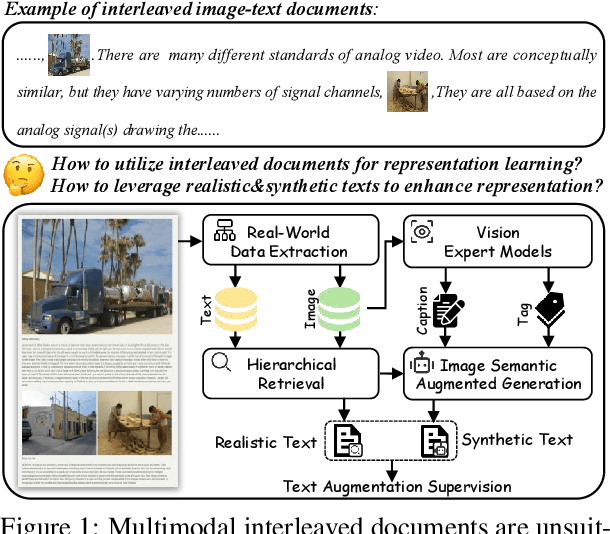
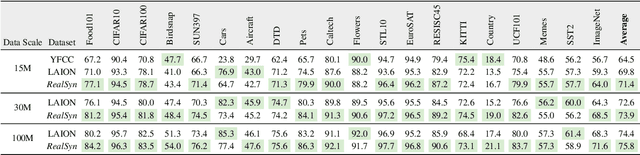
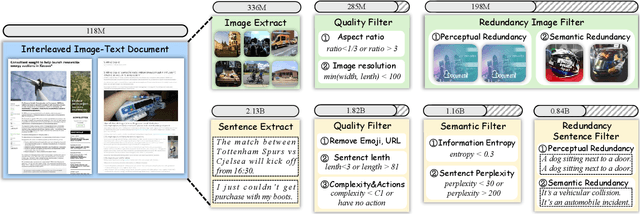
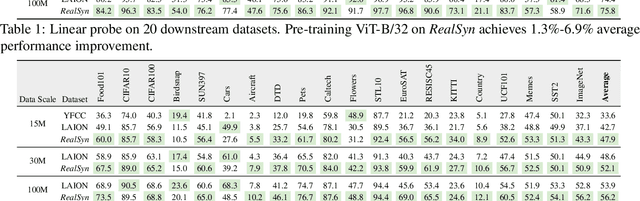
After pre-training on extensive image-text pairs, Contrastive Language-Image Pre-training (CLIP) demonstrates promising performance on a wide variety of benchmarks. However, a substantial volume of non-paired data, such as multimodal interleaved documents, remains underutilized for vision-language representation learning. To fully leverage these unpaired documents, we initially establish a Real-World Data Extraction pipeline to extract high-quality images and texts. Then we design a hierarchical retrieval method to efficiently associate each image with multiple semantically relevant realistic texts. To further enhance fine-grained visual information, we propose an image semantic augmented generation module for synthetic text production. Furthermore, we employ a semantic balance sampling strategy to improve dataset diversity, enabling better learning of long-tail concepts. Based on these innovations, we construct RealSyn, a dataset combining realistic and synthetic texts, available in three scales: 15M, 30M, and 100M. Extensive experiments demonstrate that RealSyn effectively advances vision-language representation learning and exhibits strong scalability. Models pre-trained on RealSyn achieve state-of-the-art performance on multiple downstream tasks. To facilitate future research, the RealSyn dataset and pre-trained model weights are released at https://github.com/deepglint/RealSyn.
ORID: Organ-Regional Information Driven Framework for Radiology Report Generation
Nov 20, 2024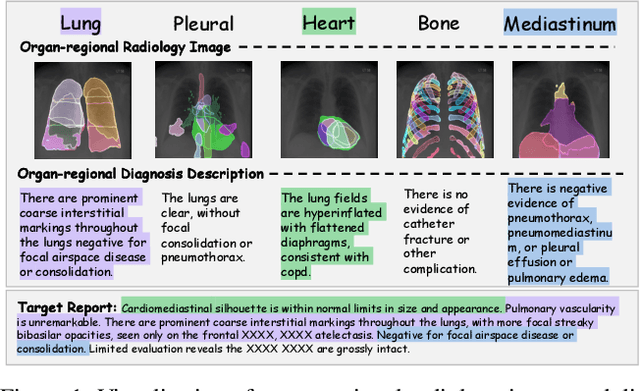
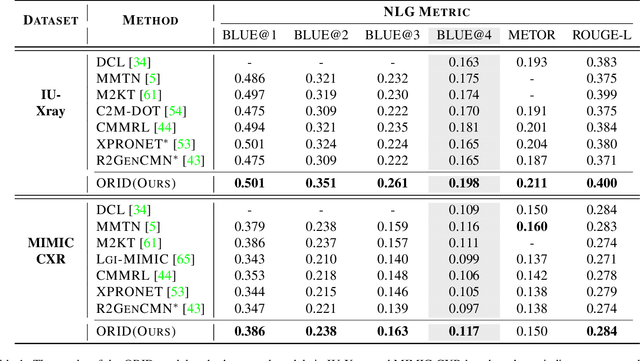
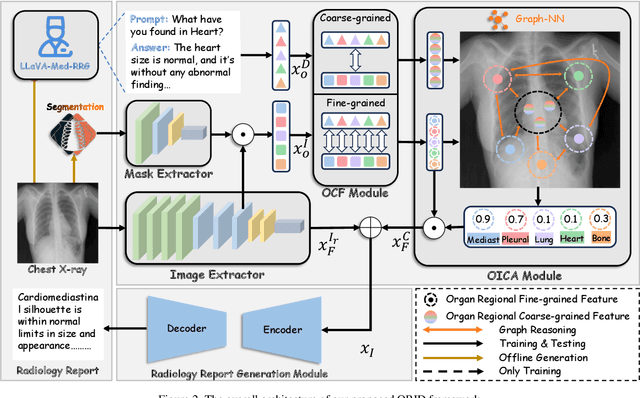
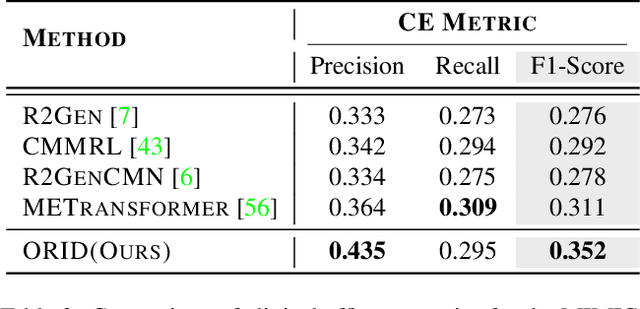
The objective of Radiology Report Generation (RRG) is to automatically generate coherent textual analyses of diseases based on radiological images, thereby alleviating the workload of radiologists. Current AI-based methods for RRG primarily focus on modifications to the encoder-decoder model architecture. To advance these approaches, this paper introduces an Organ-Regional Information Driven (ORID) framework which can effectively integrate multi-modal information and reduce the influence of noise from unrelated organs. Specifically, based on the LLaVA-Med, we first construct an RRG-related instruction dataset to improve organ-regional diagnosis description ability and get the LLaVA-Med-RRG. After that, we propose an organ-based cross-modal fusion module to effectively combine the information from the organ-regional diagnosis description and radiology image. To further reduce the influence of noise from unrelated organs on the radiology report generation, we introduce an organ importance coefficient analysis module, which leverages Graph Neural Network (GNN) to examine the interconnections of the cross-modal information of each organ region. Extensive experiments an1d comparisons with state-of-the-art methods across various evaluation metrics demonstrate the superior performance of our proposed method.
Croc: Pretraining Large Multimodal Models with Cross-Modal Comprehension
Oct 18, 2024
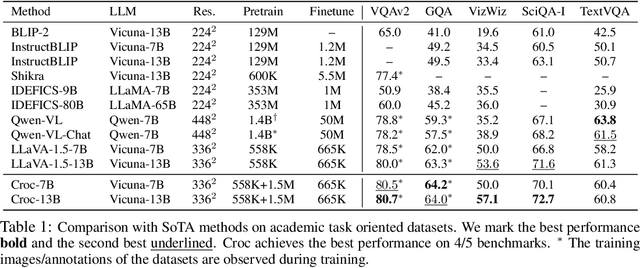

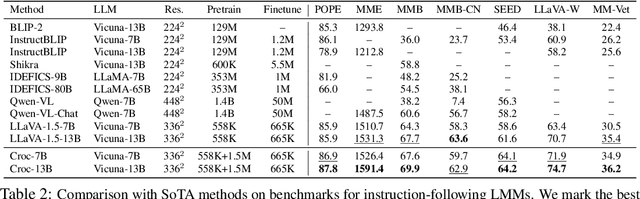
Recent advances in Large Language Models (LLMs) have catalyzed the development of Large Multimodal Models (LMMs). However, existing research primarily focuses on tuning language and image instructions, ignoring the critical pretraining phase where models learn to process textual and visual modalities jointly. In this paper, we propose a new pretraining paradigm for LMMs to enhance the visual comprehension capabilities of LLMs by introducing a novel cross-modal comprehension stage. Specifically, we design a dynamically learnable prompt token pool and employ the Hungarian algorithm to replace part of the original visual tokens with the most relevant prompt tokens. Then, we conceptualize visual tokens as analogous to a "foreign language" for the LLMs and propose a mixed attention mechanism with bidirectional visual attention and unidirectional textual attention to comprehensively enhance the understanding of visual tokens. Meanwhile, we integrate a detailed caption generation task, leveraging rich descriptions to further facilitate LLMs in understanding visual semantic information. After pretraining on 1.5 million publicly accessible data, we present a new foundation model called Croc. Experimental results demonstrate that Croc achieves new state-of-the-art performance on massive vision-language benchmarks. To support reproducibility and facilitate further research, we release the training code and pre-trained model weights at https://github.com/deepglint/Croc.